Durban’s Deaf Speak Through Silence
- chris nhlanhla makhaye
- May 9
- 7 min read

By CHRIS MAKHAYE
In the port city of Durban, the noisy car hoots, the throb of music spilling from shopfronts, hawkers calling out to passing customers, and drinks swirling in the hands of those unwinding after a long week make the local The Workshop Mall its usual theatre of sound.

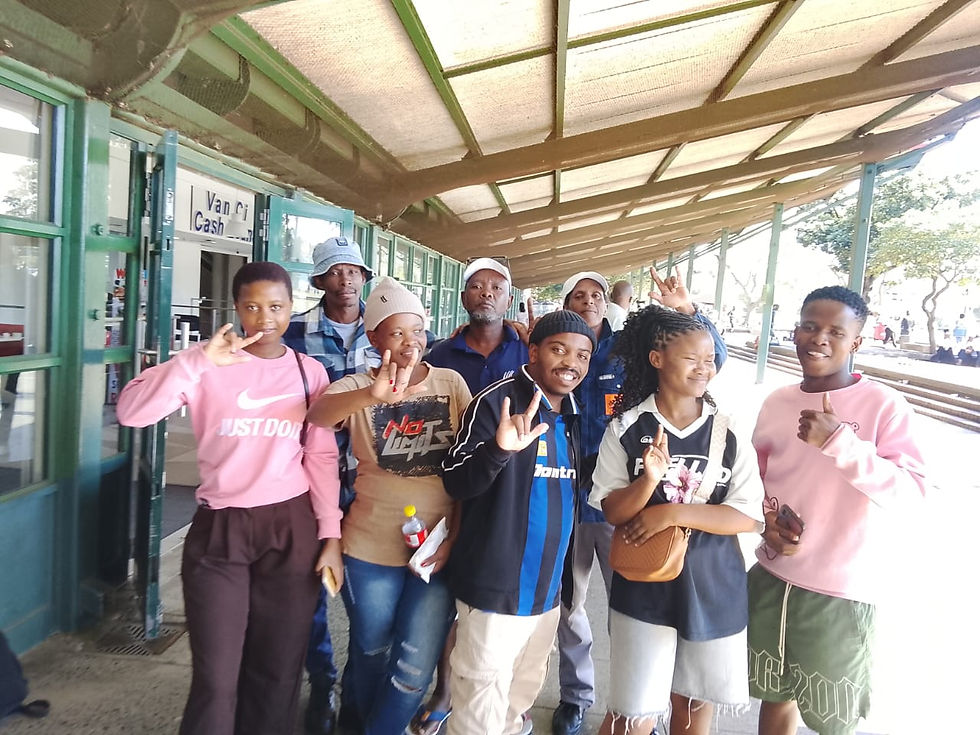
On this Friday, 8 May 2026, it was no different. The air pulsed with chaos, the kind of rhythm that defines the city’s heartbeat. Yet, on the western edge of The Workshop, at Gugu Dlamini Park, silence rose above the din. This spot, occupied by the deaf, has long been accepted by all and sundry as theirs — a place where they can unwind, laugh, talk about their frustrations, and build relationships amongst their own. Amid the noise of Durban, this corner became their sanctuary, a place of belonging and recognition.
Young Voices of Frustration and Hope
The majority of those gathered in this spot were young, in their early twenties and thirties, dressed in sweaters, designer takkies, and even a few in their workwear, having come straight from their jobs.
Siphesihle Bhengu, a 27‑year‑old Berea College second‑year student from Ntuzuma, about 20 kilometres north of Durban’s CBD, said he often faced discrimination and even laughter when he tried to communicate with people using sign language. “Sometimes they think I am playing fools,” he explained. Although he does not trust politics or politicians, he said he would nevertheless vote in the upcoming elections. “I will vote the MK Party because I think it is the only one that still caters for the poor people like us. In the past elections I voted for the Economic Freedom Fighters, but now I’m not happy about its stance on a number of issues.”
Next to him was Nelly Fihlani, a 24-year-old woman who hails from the Eastern Cape and arrived in Durban to study and look for economic opportunities. She said she heard about The Workshop corner a few years ago and she now goes there often to unwind.
Having finished her studies, she remains unemployed. She said she is not happy about the political and social situation in South Africa as there are very few opportunities for young people to grow and develop themselves. “But I will still vote…..I will cast my vote for the EFF as I believe it still speaks to the frustrations of young people like myself who felt excluded from jobs and opportunities.
Also in the vicinity was Wendy Shusha, 23, also from the Eastern Cape, admitted she was not interested in voting at all, weary of how little society accommodates her disability.
An older man from Inanda, who declined to give his name, said he saw no point in participating in elections. “I will not bother to vote. We don’t have services. Where I live, in Inanda the potholes are big, crime is high and many people are unemployed. There is no point in voting because the people we vote for abandon us soon after the elections,” he said, his hands moving sharply in sign language, his face etched with frustration.
On another Friday, The Quest team met a young couple who said they had first encountered each other at The Workshop a few years ago. Now they had a little boy, who can speak, and the family had moved in together. They told us they plan to get married once they secure enough funds. “All our friends here at The Workshop would be invited,” the young woman said, smiling as her son played nearby.
A Mother’s Daily Struggle Raising Deaf Children
A young woman in her early thirties from Inanda arrived with her two boys, still in their school uniforms. She declined to give her name, but explained that her sons — like her — can neither speak nor hear. She has been coming to this corner of The Workshop for years. “It has become like a ritual, because it is here where we find peace and comfort. There are very few places in Durban, or even in South Africa, where we can express ourselves in our own language, among our own. Elsewhere we are met with suspicion, or even mocked and laughed at,” she said.
Raising her boys in a world that does not fully understand or comprehend the life of a deaf person has been a daily struggle. At school, teachers often lack the training to communicate with them, leaving the boys isolated in classrooms meant to nurture them.
“Now they go in a school, here in town, that can understand them,” she said.
She recounted how as deaf people find it extremely hard to navigate. “In shops, as in taxis, strangers grow impatient when we cannot respond quickly. Even in healthcare, doctors sometimes dismiss our needs because we cannot explain ourselves in spoken words,” she said, adding that, for her, Gugu Dlamini Park is not just a meeting spot — it is a refuge, a place where her children can grow up surrounded by others who understand them, where laughter and conversation flow in sign language without fear of ridicule.
Amid this youthful energy stood 44‑year‑old Sipho Cele, from Umlazi township, about 17 kilometres south of Durban’s CBD. He was the oldest in the group, a man who has been around, having worked for Wits University in Johannesburg, in the sign language department, before returning home. “South Africa, and Durban in particular, is very difficult for the deaf and mute to be just themselves,” he said. “From taking taxis, to buying in shops, to finding employment — everything is a struggle, despite the country having one of the most progressive constitutions, which guarantees employment and full rights for the disabled.”
This sentiment was echoed by all around him, made up of people who live poor communities surrounded by grinding poverty.
Systemic Failures
The statistics tell a story of its own. South Africa has more than 3.3 million people living with disabilities, yet only 1.2% of the workforce is made up of disabled employees. For the deaf and mute, this exclusion is felt daily — in taxis where drivers grow impatient, in shops where communication breaks down, and in workplaces where opportunities are scarce. Despite the recognition of South African Sign Language as the country’s twelfth official language, many deaf people say the reality on the ground is one of invisibility.
The debates at Gugu Dlamini Park were as sharp as anywhere else in South Africa. On this particular Friday, the biggest talking points were the recent marches against illegal immigration and its attendant xenophobic attacks and hate speech. Another trending topic was the upcoming local government polls, which is stated to take place on 4 November 2026. Opinions flew across the circle in rapid bursts of sign language, reflecting the same anxieties and hopes that ripple through the broader society — but with the added frustration of being excluded from mainstream political discourse.
Conducting interviews in this space was a test of patience and persistence. Each question had to be scribbled onto a phone, passed to an intermediary who translated it into sign language, and then carefully transcribed back into words when the subject responded. Whenever clarity was needed, the cycle began again — question, translation, response, transcription. It was one of the most time‑consuming interviews I have ever conducted, but also one of the most revealing. In that painstaking process lay the truth of how much effort it takes for deaf South Africans to be heard in a country where only 0.02% of the population — about 12,400 people — reported using South African Sign Language in the 2022 Census, a steep decline from 255,000 in 2011.
Dr. Lisa Nhlapo, a sign language court interpreter and researcher, said the struggles voiced at Gugu Dlamini Park reflect a much larger crisis facing South Africa’s deaf community.
“I have been to Gugu Dlamini Park several times myself. I know it’s a spot where deaf people most secure, amongst their own. It is where they are able to express their fustrations, problems and joys,” she said.
“We have one of the most progressive constitutions in the world, and South African Sign Language has now been recognised as the twelfth official language. But recognition without resources is meaningless. Deaf people still face enormous barriers in education, healthcare, employment, and even in political participation,” she explained.
She recalled a recent case she interpreted. “Last week I was interpreting a case of a deaf person who didn’t even understand the sign language because these are learnt at school and he didn’t go to school. We had to hire an interpreter to explain his hand gestures. That he didn’t go to school was not the fault of his own because in the past there were very few schools which could teach deaf people and even fewer teachers who understand the sign language. That is why, in the past, deaf people were hidden in the home, a shame to the parent and in adulthood they had to fend for themselves.,” she said.
Nhlapo added that many deaf and generally disabled people struggle to access to services, they are also discriminated when it comes accessing jobs because companies don’t know how to handle and treat deaf people.
“Although we commend our government for introducing sign language as the twelfth official language, the same government is promoting the learning of Mandarin instead of extending sign language to the rest of the population,” she said.
Dr. Nhlapo explained that the Durban Deaf Centre, which she runs, helps the deaf to deal with the social issues that affect them. “Sometimes there would be a clash of cultures. For example, the parents would have ubuntu culture while their deaf children would have deaf culture, which means looking at the person in the eye, pointing at him and using other hand gestures that other people may find offensive or even confusing.”

Endnote
The Workshop’s Gugu Dlamini Park little corner continues to be the spot where the deaf gather not only to be heard, but to belong. Their voices may be silent, but their struggles echo loudly – as a reminder that even in quiet, there is power, and even in silence, there is hope. TQ
Sidebar
Deafness in Numbers
South Africa
Around 12 million people have some hearing loss.
Of these, 5 million live with a hearing disability.
About 600,000 are Deaf, using South African Sign Language (SASL).
Yet only 0.02% of the population reported SASL use in Census 2022 — down sharply from 255,000 in 2011.
Worldwide
Over 430 million people have disabling hearing loss.
By 2050, nearly 700 million will need hearing rehabilitation.
80% live in low‑ and middle‑income countries, where access to sign language education and healthcare is limited.
Rights vs. Reality in South Africa
The Constitution guarantees equality and dignity, and SASL is now the 12th official language.
In practice, Deaf South Africans face:
Education gaps — few teachers fluent in SASL.
Healthcare barriers — hospitals rarely provide interpreters.
Employment exclusion — only 1.2% of the workforce is disabled, with Deaf people among the most marginalised.
Political alienation — campaigns and ballots seldom accessible in SASL. TQ


Comments