Minister Proclaims November 4 Poll Amid Fears of Political Hits
- chris nhlanhla makhaye
- 2 days ago
- 3 min read

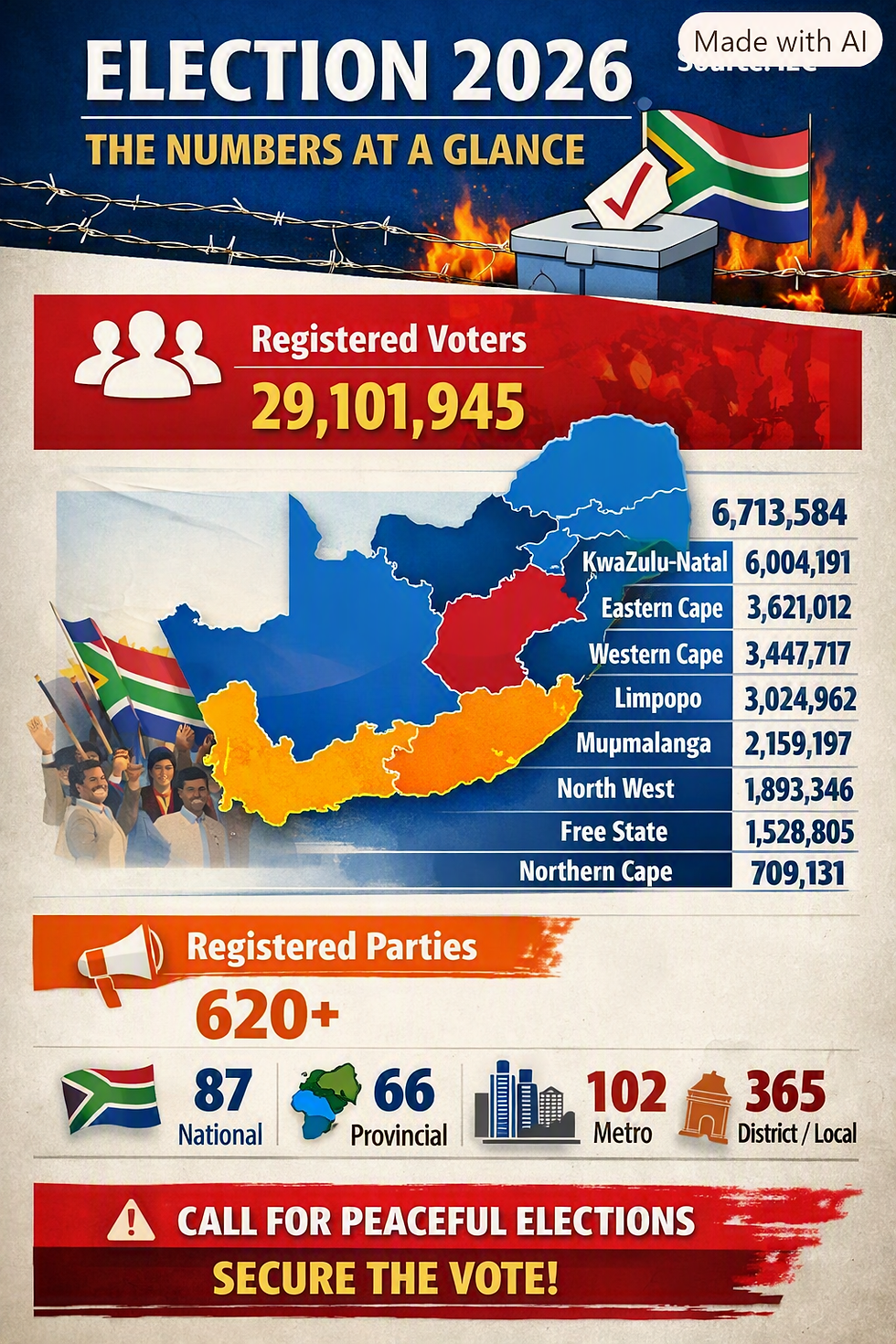
South Africa heads toward its November 4 local government elections under a cloud of fear, as Minister Velenkosini Hlabisa’s proclamation of the poll date coincides with a surge in political assassinations. With nearly 29 million registered voters and more than 620 parties contesting, the killings of councillors and candidates have cast doubt on whether democracy can unfold free of intimidation. Analysts warn that factional rivalries, especially over councillor positions, are driving the bloodshed.

By CHRIS MAKHAYE
DURBAN - The stage is now set for South Africa’s November 4 local government elections after Minister of Cooperative Governance and Traditional Affairs Velenkosini Hlabisa officially gazetted the date on Friday.
Hlabisa’s proclamation, made just 88 days before the polls, comes amid rising fears of violence that threaten to overshadow the democratic process. It also came less than a week after the last Independent Electoral Commission’s election registration campaign drive – which happened on Saturday and Sunday.
Hlabisa declared: “Today I am making it official that the people of South Africa must have their say and bring fresh air to the local government space.” Yet his words were delivered against a grim backdrop — the brazen assassination of ANC Ward 17 councillor Sibusiso Khwela, who was gunned down in his office on Thursday in Klaarwater township near Marianhill. Police confirmed that the Political Killings Task Team has been tasked with finding his killers.
Readiness and Numbers
Soon after the minister’s proclamation, the Independent Electoral Commission (IEC) held a press conference to confirm its readiness for the polls. The IEC welcomed the announcement, condemned the violence, and unveiled the scale of participation:
Registered voters: 29,101,945
Registered political parties: More than 620 — the highest in South Africa’s history.
Provincial breakdown: Gauteng (6.7m), KwaZulu‑Natal (6m), Eastern Cape (3.6m), Western Cape (3.4m), Limpopo (3m), Mpumalanga (2.1m), North West (1.8m), Free State (1.5m), Northern Cape (709k).
The IEC stressed that these elections must be free and fair, urging law enforcement to apprehend perpetrators of violence and communities to safeguard democracy.
Rising Toll of Political Killings
Khwela’s murder is the latest in a string of assassinations:
Aaron Makola (EFF), shot dead near Delmas, Mpumalanga.
Sinovuyo Dyokwe (DA), gunned down in Du Noon, Cape Town.
Five MK Party members, including Slindile Ntshangase and Thandeka Ntshangase, slain in KwaZulu‑Natal.
The South African Local Government Association (SALGA) condemned the killings, warning that they erode democracy and discourage citizens from serving in public office.
Historical Precedent: 2021 Elections
The current wave of violence recalls the 2021 local government elections, which were preceded by bloody incidents. In October 2021, ANC Ward 101 councillor Siyabonga Mkhize was ambushed and shot dead in Cato Crest, Durban, along with his bodyguard Mzukisi Nyanga, just days before the polls. Despite his death, Mkhize won the ward posthumously. His successor was later arrested alongside alleged hitmen for the murder and remains in custody awaiting trial.

Rising Tensions Ahead
With parties now nominating candidates, tensions are rising across the country. Analysts warn that factional disputes and unresolved rivalries are fueling the bloodshed. As the countdown to November 4 begins, authorities face the dual challenge of ensuring the IEC’s operational readiness while restoring public confidence that candidates and communities can participate in democracy without fear.
Professor Theo Neethling, a political scientist in the Department of Political Studies and Governance at the University of the Free State, explained in an interview with the African News Agency on June 27, 2026 that political murders and election‑related violence typically intensify during candidate selection and the build‑up to elections. He noted that this trend reflects the heightened internal competition for councillor positions, which are regarded as crucial stepping stones to influence and patronage at the local level. TQ


Comments