On a Bus to Tafelkop
- chris nhlanhla makhaye
- Apr 10
- 5 min read

Updated: Apr 11
By CHRIS MAKHAYE

Wednesday afternoon this week — at exactly 5pm — the Olympic bus pulled out of Durban’s bustling market rank, leaving behind the noise of traders and the comforting smell of cooked food. Inside, the atmosphere shifted almost immediately.
Greetings were exchanged across the bus aisles, familiar faces acknowledged with nods and quiet smiles.
This was more than a commute — it was a daily ritual.
For more than 40 years, this arrangement between Olympic Bus Services and the communities along its route has endured. Even the local taxi association—normally fierce in guarding their routes—respects this long‑standing agreement, a rare show of cooperation in the transport sector.
Its route is well-worn: collecting dock and factory workers from Dalton, Victoria Mxenge Hospital, Rossburg, Clairwood, Mobeni and Chatsworth, before heading south-west to Inteke and finally Tafelkop.
Moving community
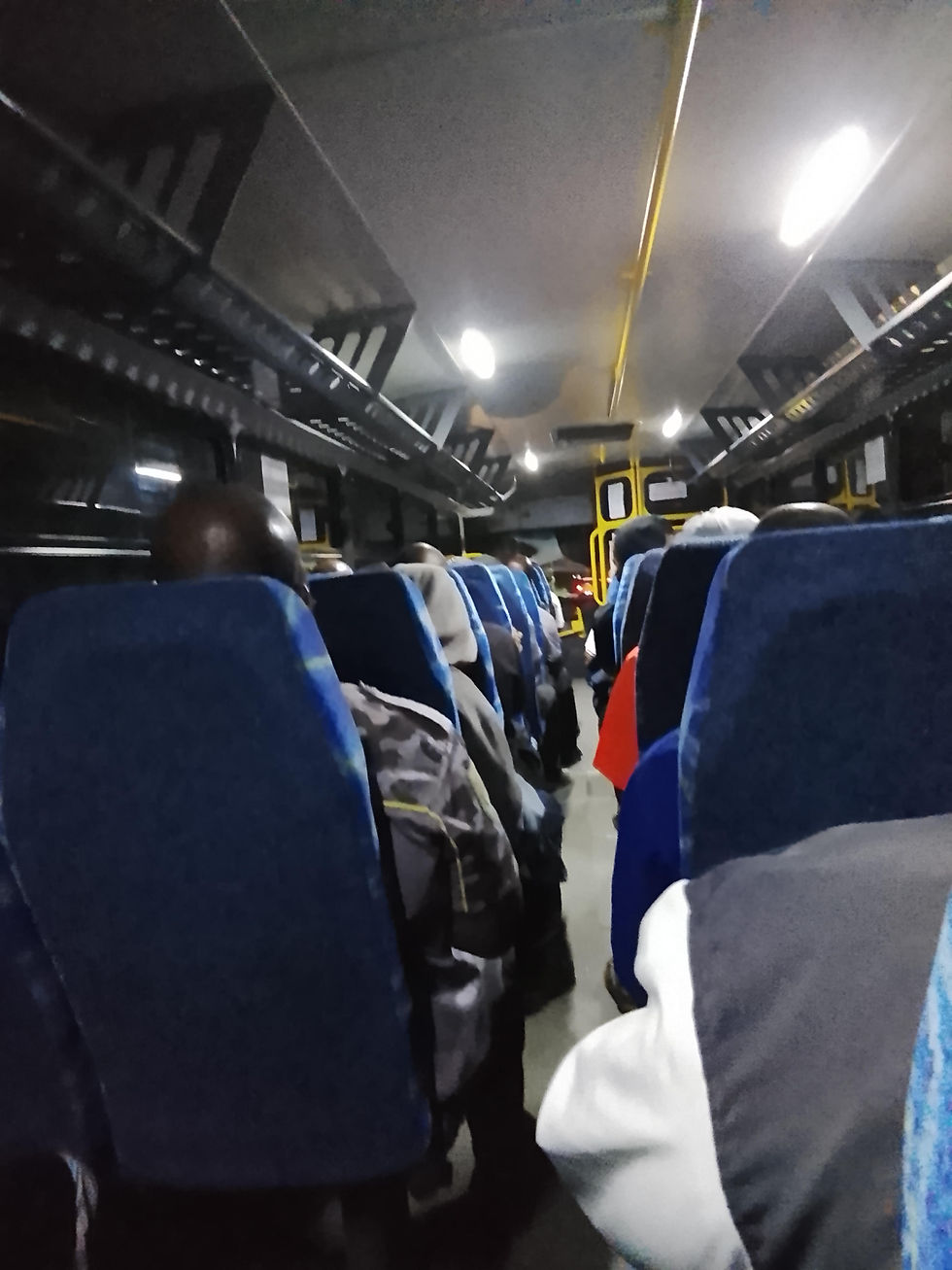
But, over time, the bus has become a kind of moving village — a place where people who may not know each other’s names still recognise each other’s lives.
The bus passes the Umlazi River on its way to Inteke and then Tafelkop.
It was here, during the 2022 floods, that tragedy struck: a bus carrying commuters was swept away.
Some passengers managed to escape through windows and doors, but the driver and an elderly woman perished.
The woman’s body and the bus carcass were later recovered, but the driver’s body was never found.
Even now, as the bus approaches the river, conversations soften. Some glance outside, others fall briefly silent — a shared memory carried quietly among them.
A Journey Interrupted
The journey, like many others, was not without its interruptions. Near Victoria Mxenge Hospital, the driver had to reroute after a truck bound for Durban Harbour broke down, blocking the access road.
Later, in Chatsworth, an accident involving two cars slowed traffic to a crawl, delaying the trip by nearly 20 minutes as the emergency workers attended to the victims and cleared the scene.
But there was little irritation. Instead, passengers settled into the delay.
A packet of snacks made its way across seats, someone cracked a joke, and laughter rippled gently through the bus. A woman was easing the hunger pains with a cobble of mielies.
Time, in these moments, seemed less urgent — softened by shared experience.
The Voices of Commuters
Among the regulars is 66-year-old Khetho Ximba, recently called back from retirement to lend his experience to his company.
He has watched the bus community evolve over the years — some faces disappearing, new ones taking their place — but the spirit has remained.
“On this bus we share our frustrations, our joys, our limitations. It has become a community of its own,” he said.
A younger traveller, seated on the back seat, spoke about the rising cost of living, especially due to the ongoing Middle East conflict.
“In just one day, a cellphone that cost R1 700 has risen to R2 000. A Samsung 826 series jumped from R4 500 to R5 000. Food, transport — everything is going up. Yet at work, salaries remain the same.”
Heads nodded in agreement.
The conversation widened, drawing in others who added their own accounts — not as complaints shouted into the void, but as shared burdens, understood without needing much explanation.
One middle-aged man, speaking anonymously, reflected on politics with visible fatigue. “I tell you politics is a scam. We just vote so people can enrich themselves. I’ve been voting since 1994 but now I don’t see a need. It doesn’t change anything.”
Though he voted for the MK Party in the 2024 general elections, he said he will not vote this time around.
Across the aisle, a woman spoke quietly but firmly about daily hardship.
“It looks like even God has forgotten that we exist. Who can be expected to live this life? If we cannot get water from the tanks, we have to fetch it from the local rivers. ”
There were no quick answers — only murmurs of recognition.
In that moment, the bus felt less like a vehicle and more like a listening space.
The Water Crisis

The following day, The Quest team found Lucky Luthuli (64) and his wife Zandile (60) collecting water from a river near the main road in Tafelkop, loading containers into their vehicle with practised efficiency.
“We have been having water problems since we arrived here in 2019,” Lucky explained.
“At first, water came through the taps, then once a week, and then not at all. Now we depend on tankers. If you are not there when they come, you make another plan.”
Zandile added: “It’s not only water — electricity is also a problem. Development in this area is like a luxury…did I tell you that we have to go to Luganda (about 10 kilometres away) just to fetch our chronic medication. The police station is in KwaNdengezi, far away.”
Gugu Mdabe, another resident of Tafelkop, also shared her frustration about electricity: “Electricity just goes off and for two or three days we will be without. Can you tell me what happens to our refrigerated food and other supply? Sometimes I feel that our woes are endless.”
Back on the bus, these realities are not news — they are daily conversation.
Advice is shared, warnings passed along, and small strategies exchanged on how to cope.

Roads and Taxi Associations
Jobe Sithole, once an Olympic driver and now a leading member of the local taxi association, spoke about the roads with quiet frustration.
“It’s not just uncomfortable for passengers — it destroys our vehicles. Every trip is a risk.”
Other taxi drivers echoed the sentiment, especially after heavy rains.
“You have to choose where to drive carefully,” one said. “Otherwise, you will be replacing tyres every day.”
Land and Politics
Inteke and Tafelkop — perched on elevated ground about 30 km south-west of Durban’s CBD near KwaNdengezi — fall under the ANC-dominated, coalition-run eThekwini Municipality. Persistent governance challenges prompted President Cyril Ramaphosa to appoint a Presidential Working Group to restore functionality.
Once reliable ANC strongholds, these areas have seen a noticeable political shift, particularly following the emergence of Jacob Zuma’s MK Party ahead of the 2024 general elections.
Voting patterns in local districts reflected growing disillusionment, a sentiment often echoed in passing conversations on the bus.

End of a journey
For weeks now, construction workers have been laying a main water pipeline intended to restore supply to Tafelkop and surrounding villages.
When water will return to household taps remains uncertain.
The local councillor could not be reached at the time of going to press.
Until then, the Olympic bus continues its steady journey — carrying workers, stories, frustrations and fleeting moments of laughter.
In the face of uncertainty, it offers something small but enduring: a sense of togetherness. For those on board, that may be just enough to get through another day. TQ


Comments